The Quiet Power of Not Complaining, How Shifting Your Words Can Transform Your Life

Some posts on these blogs contain affiliate links. If you make a purchase through one of the links, I may earn a small commission which is at no additional cost to you. I only recommend products I trust, use or believe bring genuine value.
We all do it. Sometimes it slips out without thinking, sometimes it feels justified, and sometimes it even feels like relief. Complaining can feel natural, almost automatic for some, especially in a world that often feels overwhelming and a bit frightening. But what if something that is so common is actually quietly shaping your emotional state, your mental clarity, and even your physical health?
The truth is clear, complaining is more than just words. It is a habit, a mindset, and over time, it becomes a lens through which we see the world. And while it may feel harmless at first, constant complaining can slowly drain your energy, impact your well-being, and even influence the people around you. I’ve often said to my daughter as she was growing up that everything we say and everything we do creates a ripple effect in the world. It’s a reminder to be mindful of what we’re putting out there, because our words and actions have the power to influence more than we may ever realize.
The good news is this, just as complaining is a habit, it is one habit that can be changed. And when you do make the effort to change it, the ripple effects can be very powerful.
What Complaining Really Does to Your Mind
When we complain, we reinforce negative thinking patterns. Each time we focus on what is wrong, frustrating, or unfair, we are essentially training our brain to look for more of the same.
Our brains are wired for repetition. The more we think a certain way, the easier it becomes to continue thinking that way. Complaining strengthens neural pathways associated with negativity, making it more likely that we will notice problems instead of possibilities.
Over time, this can lead to increased stress, decreased motivation, and a general sense of dissatisfaction. Even when things are going well, a habitual complainer may still feel like something is missing or not quite right.
It is not because life is worse, it is because the mind has been trained to see it that way.
The Emotional Weight of Complaining
Emotionally, complaining can amplify how we feel rather than release it. While it might feel like venting in the moment, repeated complaining often keeps us stuck in the same emotional loop.
Instead of processing frustration and moving forward, we revisit it again and again. Each time we retell the story, the emotions resurface, sometimes even stronger than before. Each time that happens, our mind and bodies react all over again.
This can lead to increased feelings of irritability, resentment, and even helplessness. It can also impact our relationships. People naturally gravitate toward positivity and warmth, so constant negativity can create distance, even when that is not our intention.
On the flip side, when we shift away from complaining, we often notice a sense of emotional lightness. We create space for gratitude, patience, and connection.
How Complaining Affects the Body
This is where it becomes even more important.
Complaining is not just a mental or emotional habit, it has physical consequences as well. When we complain, especially repeatedly, our body activates its stress response. This triggers the release of cortisol, the primary stress hormone.
Occasional stress is normal, but chronic stress can take a toll on the body. Elevated cortisol levels over time have been linked to fatigue, weakened immune function, headaches, muscle tension, and even digestive issues.
In simple terms, constant complaining can keep your body in a low-level state of stress.
Your body does not always distinguish between a real threat and a perceived frustration. So when we dwell on negative experiences, we are essentially telling our body that something is wrong, over and over again.
This can make situations feel physically worse than they actually are. I created an end-of-day printable journal designed to help people pause and notice moments of gratitude. It serves as a simple daily reflection you can return to each evening. You can purchase this reusable printable journal right here on the website in the store and use it again and again.
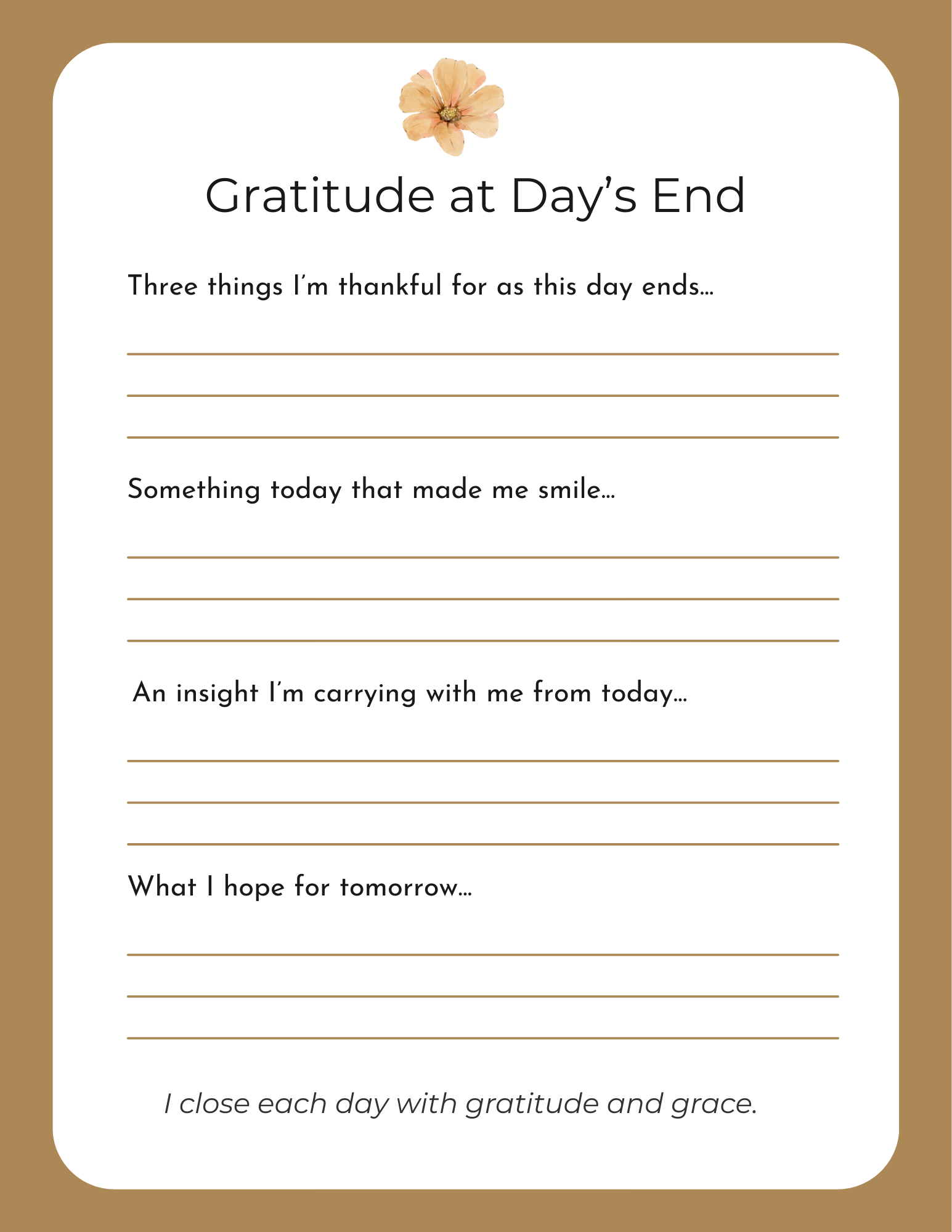
Gratitude at Day’s End
This simple printable journal can be a powerful tool for shifting your mindset. Available on the website in the store here: https://www.theheartofmindfulliving.com/store/p/gratitude-journal-printable-pdf-daily-gratitude-worksheet-self-reflection-pages-mindfulness-tracker-mental-wellness-planner
Why Complaining Can Make Things Worse
There is also a practical side to this.
When we focus on what is wrong, we often lose sight of what we can do. Complaining tends to keep us in a passive state, where we feel stuck rather than empowered.
Instead of asking, “What can I change?” we stay in “Why is this happening to me?” That shift in perspective can be the difference between feeling overwhelmed and feeling capable.
Complaining can also influence the environment around us. Negativity is contagious. When we complain frequently, it can affect the mood of a room, a team, or a family dynamic.
But here is the powerful part, positivity is just as contagious.
The Ripple Effect of Choosing a Different Response
When you begin to reduce complaining, something subtle but meaningful starts to happen.
You notice more. You pause more. You respond instead of react.
People around you may start to feel more at ease. Conversations may feel lighter. Opportunities may feel more visible. It is not that life suddenly becomes perfect, it is that your relationship with life changes.
And that shift can ripple into every area, your relationships, your work, your health, and your overall sense of well-being.
Breaking the Cycle of Constant Complaining
If complaining has become a habit, you are not alone. The key is not to eliminate it overnight, but to become aware of it.
Awareness is where change begins.
1. Notice Without Judgment
Start by just simply noticing when you complain. Maybe you need to keep a journal in order to track it. This isn’t intended as a way to criticize yourself, but more to observe your habits. What triggers the complaining? Is it stress, fatigue, frustration, or something else?
Awareness helps you interrupt the automatic response.
2. Pause Before Speaking
Give yourself a moment to think before you react. Ask yourself this question, “Is this helpful, or am I just repeating a pattern?” Sometimes that small pause is enough to shift your response. Practicing mindfulness can be a useful tool in changing this pattern.
3. Reframe the Situation
Instead of focusing on what is wrong, ask instead, “What is within my control here?” or “What is one small positive I can find?”This does not mean that your going to ignore challenges, it means your going to practice approaching them with a different mindset.
4. Replace Complaints with Solutions
If something truly needs to be addressed, then focus on a solution instead of complaining about it. This turns frustration into action, which is far more empowering that just complaining.
5. Practice Gratitude Daily
I can’t stress this point enough, practicing gratitude is one of the most effective ways to counteract negativity. Even small acknowledgments of thanks can shift your focus and gradually retrain your brain.
6. Limit Negative Input
Try to be mindful of what you consume. Daily conversations, media, and environments filled with negativity can reinforce complaining habits.Choose friends and environments that uplift you and inspire you when possible.
The Role of Mindfulness
Mindfulness plays a powerful role in breaking the cycle of complaining.
At its core, mindfulness is about being present and aware without judgment. When you are mindful, you create space between your thoughts and your reactions.
Instead of automatically complaining, you notice the urge to complain. That moment of awareness gives you a choice.
You can still express concerns when needed, but you do so intentionally rather than habitually.
Mindfulness also helps regulate stress. When you are grounded in the present moment, your body is less likely to remain in a constant state of tension.
Simple practices like deep breathing, short moments of stillness, or even mindful walking can help bring you back to center.
How Long Does It Take to Change the Habit?
Habits do not change overnight, and that is okay. The good news is that research often suggests that forming a new habit can take anywhere from about 21 days to 60 days or more, depending on the person and the consistency of the effort.
The key is not perfection, it is consistency. You may catch yourself complaining and think, “I am still doing it.” That is not failure, that is progress. Awareness itself is a sign that change is already happening.
Over time, those small shifts add up. What once felt automatic begins to feel optional.
A More Empowering Way to Live
Choosing not to complain does not mean suppressing your feelings or pretending everything is perfect. It means choosing how you engage with your experiences. It means that you’re allowing yourself to feel, while also choosing not to stay stuck.
It means recognizing that your words, your thoughts, and your focus have power.
When you shift away from constant complaining, you create space for clarity, resilience, and a deeper sense of peace. You begin to respond to life with intention rather than reaction.
And perhaps most importantly, you remind yourself that while you cannot control everything that happens, you can always influence how you show up. That is where your power truly lies.
If this kind of content resonates with you, I’d love for you to stay connected. You can sign up for the bi-monthly newsletter on the website, listen to the podcast on Spotify, follow along on social media, and be sure to check out the printable resources available on the website as well.
We’re building a community, one mindful moment at a time.
